Maharana Pratap: A Symbol of Swadharma and Swaraj

Maharana Pratap: A Symbol of *Swadharma* and *Swaraj*
Veer Savarkar termed the revolt of 1857 as the "First
War of Indian Independence." In 1909, he authored a book titled *The
Indian War of Independence*. Originally written in Marathi, the book was
subsequently banned by the British government. Veer Savarkar argues that in the
writing of history, one must focus on the underlying principles driving events
rather than merely elevating subjective narratives to the status of history. He
cites the British characterization of the Indian outrage against them in 1857
as a mere "Mutiny" or "Ghadar" as a prime example—a
narrative that, in his view, amounts to nothing more than a British-centric
discourse. Conversely, from the perspective of historical scholarship,
designating the 1857 uprising as the "First War of Indian
Independence" is both factually accurate and theoretically sound, for it
was, in essence, a full-scale war. In support of this assertion, Veer Savarkar
writes that those who attribute the Ram-Ravana war solely to the abduction of
Sita, or the 1857 uprising solely to the use of cartridges greased with cow and
pig fat, fail to distinguish between mere narrative discourse and genuine
historical analysis. Veer Savarkar posits that the principles of *Svadharma*
and *Swaraj* were the true underlying causes behind both the Ram-Ravana war and
the uprising of 1857. Similarly, the book *Raja Man Singh of Amer*—authored by
Rajiv Nayan Prasad, the son of Dr. Rajendra Prasad—presents a deeply researched
analysis of Raja Man Singh's role in medieval India, demonstrating how he
safeguarded India from the tempest of religious conversion through astute
political alliances.
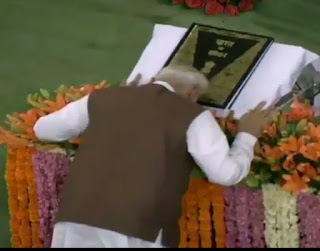
For the sake of *Swadharma* (one's righteous duty) and *Swaraj* (self-rule), Bhagat Singh, Rajguru, and Sukhdev willingly accepted the death sentence. Mahatma Gandhi articulated his views on this subject in his book titled *Hind Swaraj*. Sri Aurobindo coined the slogans of *Swaraj* and *Swadeshi* to protest against the Partition of Bengal. Netaji Subhash Chandra Bose, while residing outside India, ceaselessly struggled to liberate the nation in pursuit of *Swadharma* and *Swaraj*. This spirit is also vividly depicted in India's handwritten Constitution.
In warfare, the attainment of the objective is paramount. The
ability to make decisions in accordance with prevailing circumstances and the
demands of the time rests upon the wisdom and courage of the leader. Mahatma
Gandhi launched his first movement with the conviction that India would attain
independence. However, that movement did not succeed, and he failed to achieve
his immediate objective. Yet, this failure does not in any way diminish the
greatness of Mahatma Gandhi. Similarly, he was compelled to retract his
decision following the Chauri-Chaura incident. Likewise, the greatness, spirit
of renunciation, and sacrifice of the revolutionaries who endured torture in
*Kala Pani* (the Cellular Jail) cannot be undermined by the fact that they
filed mercy petitions. In the context of patriotism and love for the nation,
both laying down one's life and remaining alive to achieve one's objective are
equally significant; this truth can be truly grasped only by those for whom the
nation stands supreme.
To comprehend decisions and events such as the *Jauhar* of
Chittor, the Battle of Haldighati, the execution of Bhagat Singh, the
incarceration of Veer Savarkar in *Kala Pani*, Sri Aurobindo's departure to
Pondicherry, the suspension of the movement following the Chauri-Chaura
incident, the Poona Pact between Dr. Ambedkar and Gandhiji, the strategy of
advancing the freedom struggle from within the British administrative
machinery, the enlistment of Indians in the armed forces during the Second
World War, and the opposition to the Partition of India—a foundational
understanding of *Swadharma* and *Swaraj* is indispensable.
Discussions regarding changes to the academic curriculum
surface from time to time. During these discussions, comments and critiques
regarding national heroes are often advanced based on specific ideological
leanings—commentary that is frequently driven by political motives. Such a
mindset does not augur well for the task of nation-building or for the future
of the country. Therefore, it is essential that—just as the Constitution
incorporates the 'Basic Structure' doctrine—all political parties reach a
consensus on the 'Basic Structure of Indian History' along similar lines,
ensuring that the subject matter remains unaltered regardless of changes in government.

Comments
Post a Comment