Can Supreme Court direct the women reservation in legislature?
Get link
Facebook
X
Pinterest
Email
Other Apps
Can Supreme Court direct the women reservation in
legislature?
Women reservation bill seeking to advance
reservation of 33% seats for women in an expanded Lok Sabha and state Assembliesin the parliamentwasintroduced by way of Constitution Amendment 131st Bill 2026 .There was lack of numbers of votes in support of the
amendmentBill so the Bill could not be
passed and therefore, the efforts of the ruling party could not get the
desirable result. There are whispersin
the corridor of media and Courts that
now by way of Public Interest Litigation the same can be given effect through
the writ of mandamusof the Honorable
Supreme Court.
Order forwomen reservation of 30 % (20% by way of election+ 10% co opted members) in the Bar Councils as per the directions of the Apex
court is reported to beinvoked as
precedent. The question arises for the people of India, whether the same can be
replicated or not. What is the difference between the two illustrations ,in reservation of seats in theBar councils andreservation of the seats in the legislature,
which includes the state legislature and the parliament. Both are said to
beaffirmative action for the
empowerment of women.
The above conspectus reminds the first amendment of the
constitution of India, where reservation policy was challenged by one women Champakam Dorairajan. The impugned
policy of reservation was struck down by
the Honorable Supreme Court in the absence of explicit provision of enabling
clause for women for affirmative action in the constitution of India. By way of
first amendment in the constitution , article 15(4) was inserted to pave thepath for socially and educationally backward
class of people which helped the women
centric reservation or affirmative action in education.
The effect of the directions of the Apex court in
the women reservation in Bar Councils amounts to amendment in the Advocates Act 1961.The point of deliberation is whether
such direction can be issued in the exercise of judicial review? Does this not
constitute encroachment on the legislative powers of the Parliament?
This is said to be blatant violation of separation of power doctrine. It is
appropriate to mention Deoki Nandan
Agarwal case(AIR 1992 SC 96) of three judges bench of the Apex Court which
helps to understand the role of Courts in a democratic scheme of governance in
exercise of judicial restrain. It was observed -
“It is not the duty of the Court either to enlarge
the scope of the legislation or the intention of the legislature when the
language of the provision is plain and unambiguous. The Court cannot rewrite,
recast or reframe the legislation for the very good reason that it has no power
to legislate. The power to legislate has not been conferred on the Courts. The
Court cannot add words to a statute or read words into it which are not there.
Assuming there is a defect or an omission in the words used by the legislature
the Court could not go to its aid to correct or make up the deficiency. Courts
shall decide what the law is and not what it should be. The Court of course
adopts a construction which will carry out the obvious intention of the
legislature but could not legislate itself. But to invoke judicial activism to
set at naught legislative judgment is subversive of the constitutional harmony
and comity of instrumentalities.”
This order of reservation of women in Bar councils does not has binding precedence. It is said to besub silentio . It said to be a decision or rule accepted implicitly
without formal discussion. This reminds Jeet S Bisht case((2007 6 SCC 586)
wherein it was observed by three Judges Bench of the Apex Court that the
decision given in All India Judges Association Case (1993 4 SCC
288) was sub silentio. It was observed -
“16.We have carefully gone through the
above decision. We fully agree with the observations in this judgment that
Judges should get adequate salaries and allowances to enable them to function
impartially and with a free mind, but we do not agree that that decision has
laid down any principle of law that the salaries, allowances and other
conditions of Judges should be fixed by the judiciary.
17.The
salaries, allowances and other conditions of service of Judges are either fixed
by the Constitution (e.g. the age of superannuation and salaries of Supreme
Court and High Court Judges) or by the legislature or the executive. In fact
this is the position all over the world.
18.No
doubt in the aforesaid decision various direction have been given by this Court
but in our opinion that was done without any discussion as to whether such
directions can validly be given by the Court at all. The decision therefore
passed sub silentio.”
There is no ratio
decidendi in the order of reservation of women in Bar Councils except a passing
reference to the constitutional ethos
and noble cause of women empowerment.
The Supreme Court is the Highest Constitutional
Court of India. But principle of rule of law signifies that no one is above law. Even Supreme Court, can't
be above law.
Now, the moot question is, whether the decision which
is sub silentioin violation of doctrine
of precedent would set a good example in the movement of women empowerment in
India? Honest self introspection is required that ends and means must be noble,
legitimate asmuch as upholding the
constitutional morality. Does being part of Judiciary, accord special status to
the effect that basic jurisprudence is
set at rest for attaining affirmative action. What type of example it has set
for judicial discipline , judicial propriety and judicial restrain. Where are
the boundaries ? It has set a bad example of judicial activism in the name of
affirmative action.
What has changed from the era of Champakam
Dorairajan(1951) challenging the reservation policy not in consonance of the
constitutional scheme to the present daydirections amounting to amendment
of the The Advocates Act 1961? Answer is not encouraging. It has resulted in the loss , erosion and weakening of judicial
restrain , judicial discipline and judicial propriety.
There is a legitimate question for the peoplewho favour women
upliftmentand support women reservation .Whether the Apex court will dare to pass directions for
reservation in the legislature in the name of promoting the constitutional ethos
and the noble cause of women empowerment often described as affirmative action.
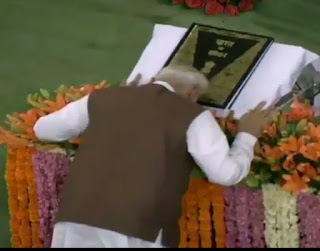
भारत के मूल संविधान (अंग्रेजी) को हस्तलिपिबद्ध/सुलेख करने का श्रेय प्रेम बिहारी नारायण (सक्सैना) को जाता है और हिन्दी में सुलेखन करने का श्रेय बसंत कृष्ण वैद्य को मिलता है। भारत के मूल संविधान को हस्तलिपिबद्ध/सुलेख करने का श्रेय प्रेम बिहारी नारायण (सक्सैना) को जाता है। मूल संविधान को हस्तलिपिबद्ध करने पर मानदेय का प्रस्ताव पं. नेहरू ने दिया था। इस पर प्रेम बिहारी ने मानदेय लेने से इंकार तो किया पर यह शर्त रखी की मूल संविधान के सभी पृष्ठों पर उनका नाम अंकित होगा। अंतिम पेज पर उनका व उनके दादाजी का नाम लिखने की मंशा व्यक्त की। पं. नेहरू ने इस शर्त को सहर्ष स्वीकार किया। मूल संविधान को हस्तलिपिबद्ध करने में पूरे छः महीने का समय लगा। 254 पेन होल्डर निब काम में आए व 303 नम्बर की निब इस कार्य के लिए काम में ली गई। इस कार्य/योगदान के लिए प्रेम बिहारी नारायण (सक्सैना) को पद्मविभूषण सम्मान से सरकार ने सम्मानित किया। देहरादून स्थित भारतीय सर्वेक्षण विभाग कार्यालय द्वारा फोटोलिथोग्राफी का कार्य पूरा किया गया। संविधान सभा के सदस्यों के हस्ताक्षर आठवीं अनुसूची के बाद 11 पेज...
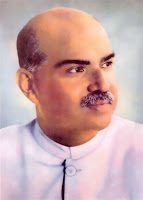
CONSTITUENT ASSEMBLY OF INDIA DEBATES (PROCEEDINGS) - VOLUME IX Tuesday, the 13th September 1949 Dr. Syama Prasad Mookerjee on Hindi National Language discussion in Constituent Assembly The Honourable Dr. Syama Prasad Mookerjee (West Bengal: General) Mr. President, Sir, we are considering a matter which is of vital importance, not to the people belonging to one or other of the provinces of India , but to the entire millions of India's population. In fact, Sir, the decision that we are about to take, even if we ignore for the time being the points of difference, vital though they may appear. to some, the decision that we are about to take is something which has never been attempted in the history of India for the last thousands of years. Let us therefore at the very outset realise that we have been able to achieve something which our ancestors did not achieve. Some Members have spoken not doubt out of the warmth of their feeling and have tried...


Comments
Post a Comment